Abbey Road, 1969 — the desk that changed the sound
How a change of equipment rewrote a band's tone — and why some people hated it.
Play Revolver and then play Abbey Road. Three years apart, same band, same studio, largely the same production team — and the second one is noticeably smoother, rounder and more even. Less spiky. Less like a room and more like a record.

The songs changed, obviously. But a large part of that difference walked into EMI Studios on a delivery truck.
Out with the valves
Until 1968, EMI's studios ran on the REDD series of consoles — valve desks, hand-built by EMI's own Record Engineering Development Department. They are now mythologised, and reasonably so: valve circuitry distorts in a way people describe as forward and lively, with a particular way of hardening as you push it.
The TG12345 replaced them. It was transistorised — solid state — and it brought two changes that mattered far more than the marketing did.
A compressor and limiter on every single channel. On the old desks, compression was outboard: a limited resource you patched in where it was most needed, which meant you decided in advance which parts of the record deserved it. On the TG, every channel had dynamics available at all times.
Different distortion behaviour. Solid-state circuits stay clean further and then misbehave differently at the top. The valve desks' particular flavour of strain — a big part of what made the earlier records sound urgent — was simply not on the menu any more.
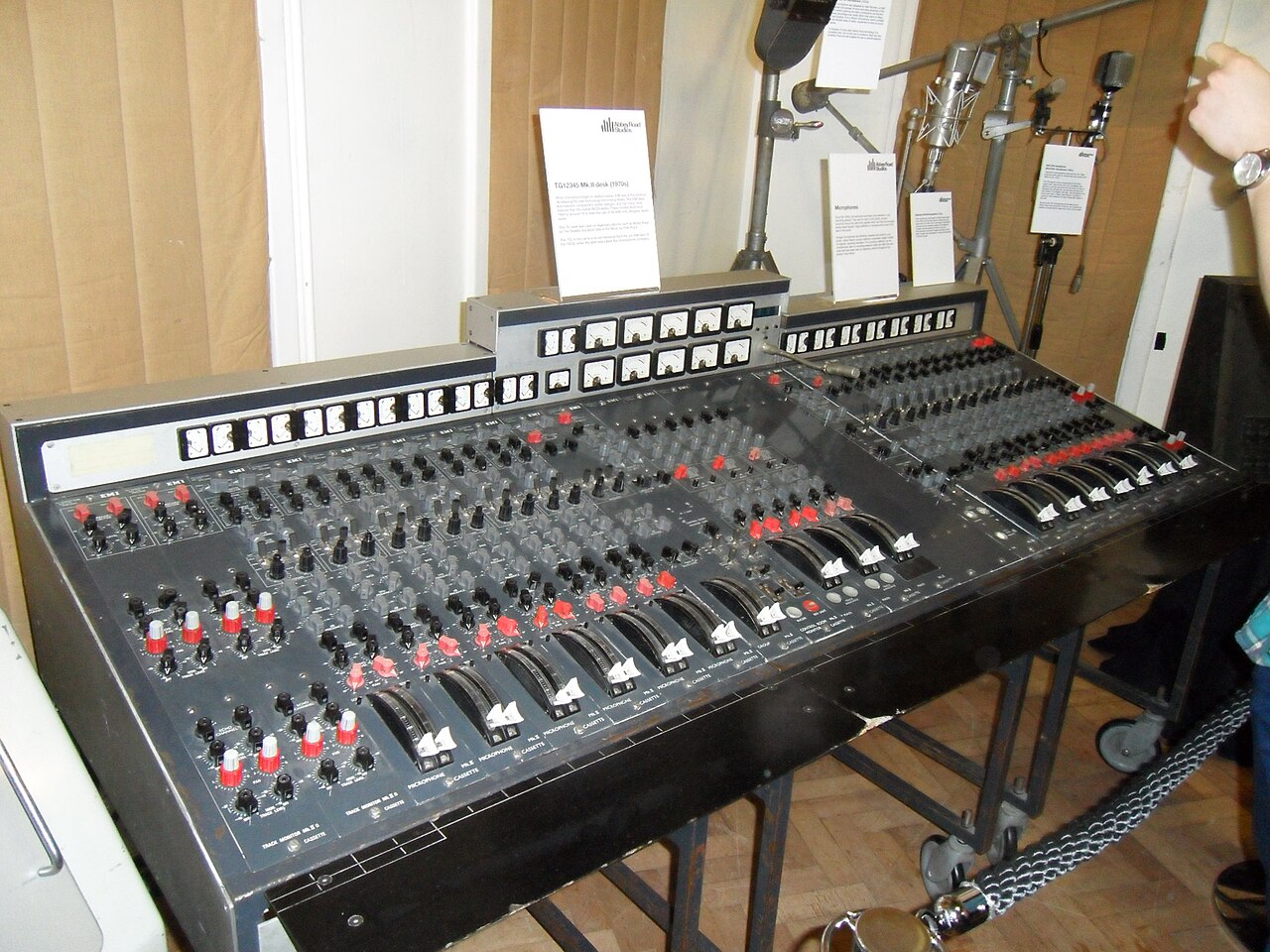
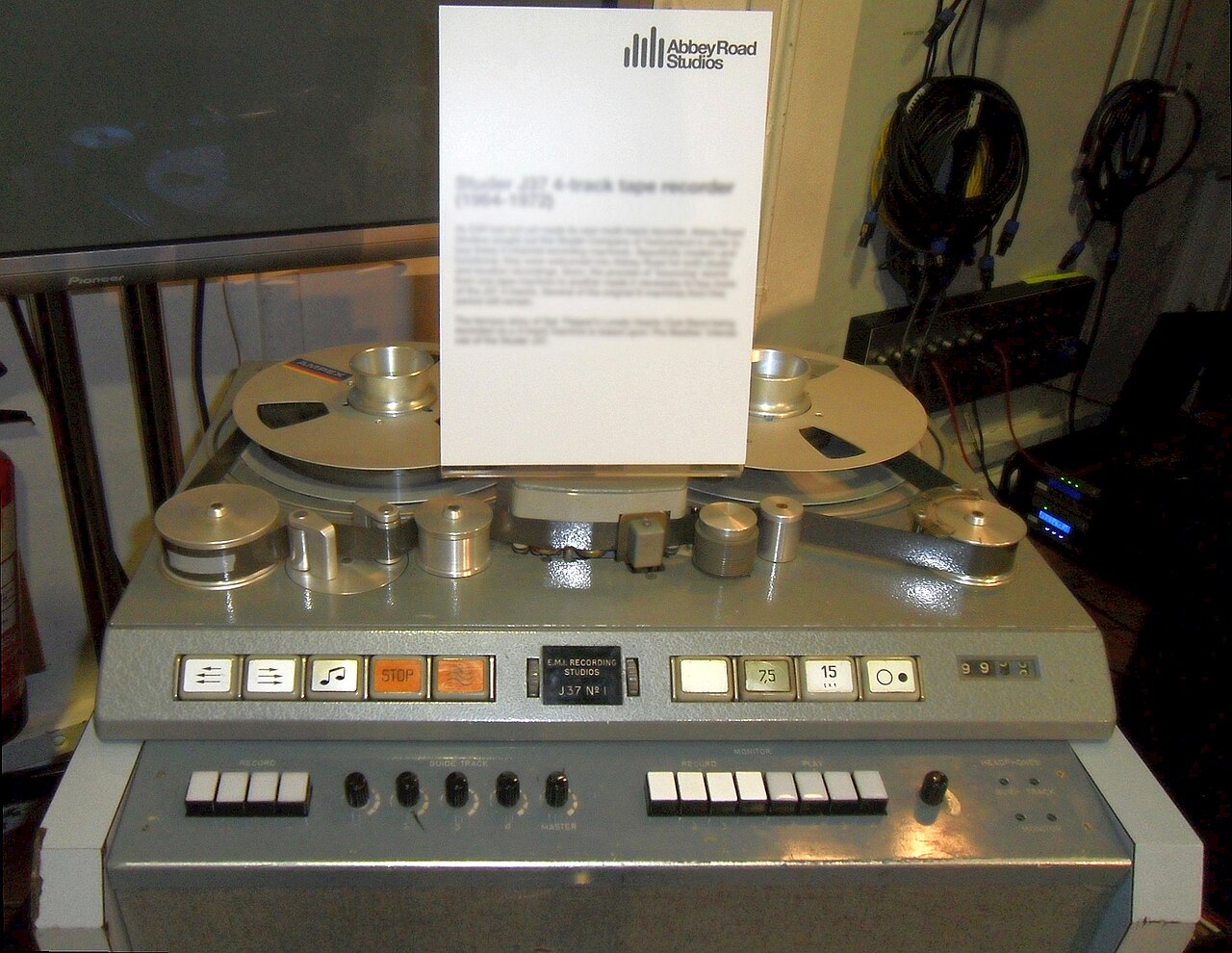
Abbey Road was the first Beatles album recorded entirely on the new console, and it was made mostly on eight-track rather than the four-track machines that had forced so much bouncing on the earlier records.
What "compression on every channel" actually does
It is worth being concrete, because this is the mechanism.
A compressor reduces the distance between the loudest and quietest parts of a signal. Put one on a bass guitar and every note sits at a similar level, so the part stops lurching and becomes a steady foundation. Put one on a vocal and the quiet phrases stay audible against the band without the loud ones dominating.
Now put one on everything, and something larger happens: the whole record becomes more even. Every element occupies a more consistent amount of space, so the mix stops jostling. Nothing jumps out; nothing disappears. That is precisely the quality people mean when they say Abbey Road sounds polished.
Listen to the bass across side two. It is round, sustained and remarkably consistent — sitting underneath the arrangement rather than fighting through it. That is a mix philosophy, and the new desk is what made it cheap enough to apply everywhere.
Not everyone was pleased
At the time, plenty of EMI staff thought the TG was a downgrade. The valve desks were exciting; the transistor desk was correct. Geoff Emerick, who engineered much of the band's most adventurous work, was among those who preferred the older sound.
This is a recurring pattern and worth naming. New equipment is usually cleaner than what it replaces, and cleaner is not automatically better. Every generation of gear removes a distortion that the previous generation had learned to use musically. The 1970s lost valve saturation and spent the 1990s buying it back; the 1990s lost tape compression and spent the 2000s emulating it.
Abbey Road is the interesting case because both sides are right. It genuinely does not sound like Revolver, and it genuinely is a beautifully made record. The console did not make it worse. It made it different, in a direction the band was already heading.
The rest of the toolkit
Two other things shape the record's sound.
Artificial double tracking. ADT was invented at Abbey Road in 1966 by Ken Townsend, after Lennon complained about having to sing everything twice. It takes a signal, delays it by a small and slightly wavering amount, and plays it back alongside the original — producing the thickness of a doubled take from a single performance. By 1969 it was routine, and it is a large part of why the vocals sit so wide.
The Moog. A Moog IIIp appears on several tracks — "Here Comes the Sun", "Because", "Maxwell's Silver Hammer". It is one of the first uses of a synthesiser on a mainstream pop record, and notably it is used as a texture rather than a novelty. On "Because" it doubles the vocal harmonies; you can miss it entirely.
What to take from it
The lesson is not that you need a particular console. It is about what consistent, gentle dynamic control across every element does to a record: it trades excitement for cohesion, and it does so whether or not you decided to.
That trade is still the central decision in mixing and mastering. Compress lightly across everything and a record gains solidity and loses some of its jump. Compress selectively and it keeps its edges and some of its mess.
Abbey Road is the definitive argument for the first option, made at the moment the option first became easy. Which is also a reminder that a lot of what we hear as artistic signature started life as whatever the equipment made convenient.
Try it on your own mix
Wavely shows the whole chain — every stage, every parameter, and why each decision was made. Adjusting it and re-mastering is free on every plan.
Get started free →